
A Physician’s Complete Guide to Authentic Ayurvedic Purification Therapy
“More than a detox. More than a wellness retreat. Panchakarma is one of Ayurveda’s most sophisticated physician-guided therapeutic systems.”
If you are exploring Ayurveda for chronic health concerns, preventive healthcare, stress recovery, or healthy ageing, you have probably encountered the term Panchakarma. It is frequently described as an Ayurvedic detox, cleansing programme, or wellness retreat. While these descriptions are widely used, they do not accurately represent what Panchakarma is according to the classical Ayurvedic texts.
In authentic Ayurveda, Panchakarma is neither a spa therapy nor a standardized detox package. It is a comprehensive system of Shodhana Chikitsa (Purification Therapy) that aims to restore physiological balance by eliminating excessively aggravated Doshas (Vata, Pitta and Kapha) through carefully selected therapeutic procedures after meticulous preparation. Rather than focusing solely on symptom relief, Panchakarma seeks to correct the underlying imbalance responsible for disease while supporting the body’s innate capacity for healing.
For more than two millennia, Panchakarma has occupied a central place in Ayurvedic medicine. Classical physicians prescribed these therapies not only for the management of chronic diseases but also for preserving health, preventing seasonal illnesses, preparing the body for Rasayana (Rejuvenation Therapy), and promoting healthy longevity.
Unlike many modern wellness programmes, authentic Panchakarma is never “one size fits all.” Every treatment begins with a detailed physician consultation assessing the individual’s Prakriti (Natural Constitution), Vikriti (Current Imbalance), digestive and metabolic capacity (Agni), tissue strength, age, season, lifestyle, and stage of disease. Only after this evaluation is an individualized treatment protocol designed.
This emphasis on personalization explains why Ayurveda repeatedly cautions that Panchakarma should always be performed under the supervision of a qualified Panchakarma physician. The therapy selected for one patient may be entirely unsuitable for another with the same diagnosis.
What Does Panchakarma Mean?
The word Panchakarma (Pañcakarma) is derived from two Sanskrit words: Pancha, meaning five, and Karma, meaning therapeutic procedures or physician-directed interventions. Together, Panchakarma literally translates as “the five therapeutic procedures.”
However, this simple translation does not fully convey its significance.
In Ayurveda, the term Karma refers not merely to an action, but to a carefully selected medical procedure performed with a specific therapeutic purpose. Each of the five Panchakarma procedures has a distinct indication, preparation, method of administration, and expected outcome. They are prescribed only after a thorough clinical assessment and are tailored to the individual’s constitution, disease condition, age, strength, digestive capacity, and the season.
Panchakarma therefore represents far more than five treatments. It is a systematic therapeutic approach belonging to Shodhana Chikitsa (Purification Therapy), one of the two principal branches of Ayurvedic treatment. While Shamana Chikitsa (Pacifying Therapy) manages disease through diet, lifestyle, and medicines, Shodhana Chikitsa seeks to eliminate excessively aggravated Doshas (Vata, Pitta, and Kapha) from the body after appropriate preparation, thereby restoring physiological balance according to Ayurvedic principles.
The Classical Principle Behind Panchakarma
One of the most important principles of Panchakarma was explained by the celebrated commentator Chakrapani, who clarified that these therapies are designed to remove aggravated Doshas through the nearest natural route of elimination, but only after they have been properly mobilized from the tissues into the gastrointestinal tract through preparatory therapies.
This principle is fundamental to authentic Panchakarma.
In other words, the objective is not simply to induce vomiting, purgation, or enema. The aim is to first prepare the body so that aggravated Doshas become suitable for elimination. Without this preparation, purification is considered incomplete and may even be inappropriate.
This is one of the key reasons why authentic Panchakarma cannot be reduced to a “detox package” or a collection of wellness treatments. It is a carefully staged medical process that follows precise clinical principles laid down in the classical Ayurvedic texts.
Classical Foundation
वमनं रेचनं नस्यं निरूहश्चानुवासनम् ।
एतानि पञ्चकर्माणि कथितानि मनीषिभिः ॥
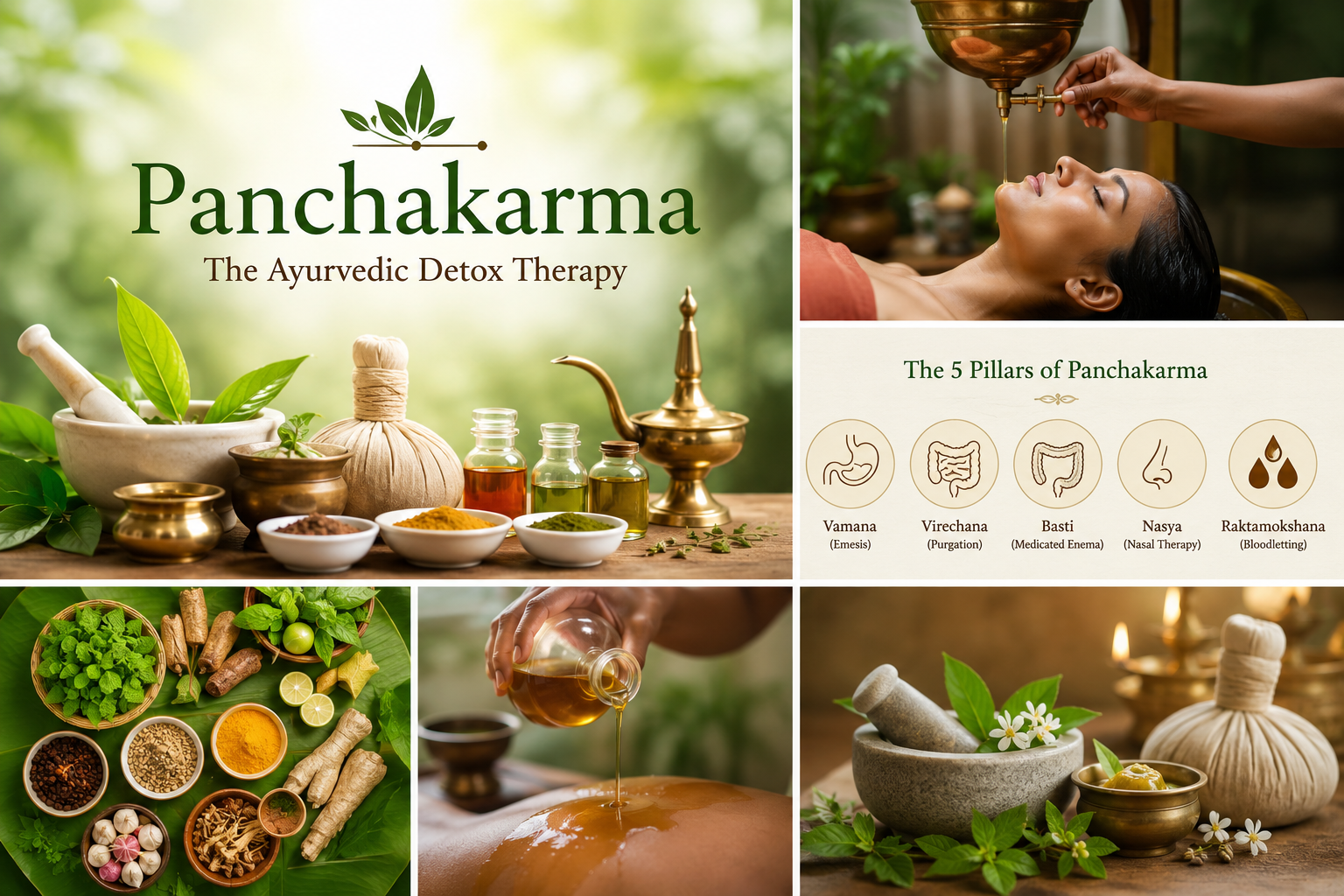
“Vamana (Therapeutic Emesis), Virechana (Therapeutic Purgation), Nasya (Nasal Administration of Medicines), Niruha Basti (Medicated Decoction Enema), and Anuvasana Basti (Medicated Oil Enema) are the five Panchakarma procedures described by the ancient sages.”
— Sushruta Samhita, Uttara Tantra 8/70
The Five Classical Panchakarma Procedures
The classical Ayurvedic texts describe the following five physician-guided purification therapies:
1. Vamana (Therapeutic Emesis)
A controlled therapeutic procedure that eliminates aggravated Kapha Dosha, primarily affecting the respiratory system, upper gastrointestinal tract, and related disorders.
2. Virechana (Therapeutic Purgation)
A medically supervised purgation therapy used to eliminate aggravated Pitta Dosha, commonly prescribed for conditions involving the liver, skin, gastrointestinal tract, and systemic inflammatory disorders.
3. Niruha Basti (Medicated Decoction Enema)
A therapeutic enema prepared using herbal decoctions, oils, and other medicinal ingredients. It is regarded as one of the most important therapies for correcting disorders associated with Vata Dosha, particularly neurological, musculoskeletal, and degenerative conditions.
4. Anuvasana Basti (Medicated Oil Enema)
A nourishing oil-based enema that supports lubrication, nourishment, and regulation of Vata Dosha. It is frequently used alongside Niruha Basti as part of a comprehensive treatment protocol.
5. Nasya (Nasal Administration of Medicines)
A procedure in which medicated oils, herbal juices, or powders are administered through the nasal passages to manage disorders affecting the head, neck, nose, sinuses, and sensory organs. In Ayurveda, the nose is regarded as an important gateway to therapies directed towards the region above the clavicle.
Each of these therapies serves a distinct purpose and is selected only after careful physician evaluation. Not every patient requires all five procedures. Depending on the clinical condition, one therapy, a combination of therapies, or none at all may be appropriate.
Why Doesn’t Panchakarma Mean “Five Massages”?
One of the most common misconceptions among international visitors is that Panchakarma refers to a collection of relaxing Ayurvedic massages.
This is not supported by the classical Ayurvedic texts.
Treatments such as Abhyanga (Therapeutic Oil Massage), Shirodhara (Continuous Streaming of Medicated Liquid over the Forehead), Pizhichil (Therapeutic Oil Bath), and Shashtika Shali Pinda Sweda (Medicated Rice Bolus Fomentation) are valuable Ayurvedic therapies and are widely practised, especially in Kerala. However, these are generally considered supportive procedures based on the principles of Snehana (Oleation Therapy) and Swedana (Sudation Therapy). They are often used before, during, or after Panchakarma to prepare the body or enhance therapeutic outcomes.
Authentic Panchakarma refers specifically to the five purification procedures described in the classical texts. Understanding this distinction helps patients choose centres that practise physician-guided Ayurveda rather than generic wellness programmes.
Physician’s Perspective
In our clinical practice, many international guests arrive expecting Panchakarma to begin with massages on the very first day. In reality, the initial consultation often reveals that different patients require different preparatory measures, and some may not need all five purification procedures at all. Authentic Panchakarma is individualized—not standardized—and its success depends as much on accurate assessment and preparation as on the purification itself.
