
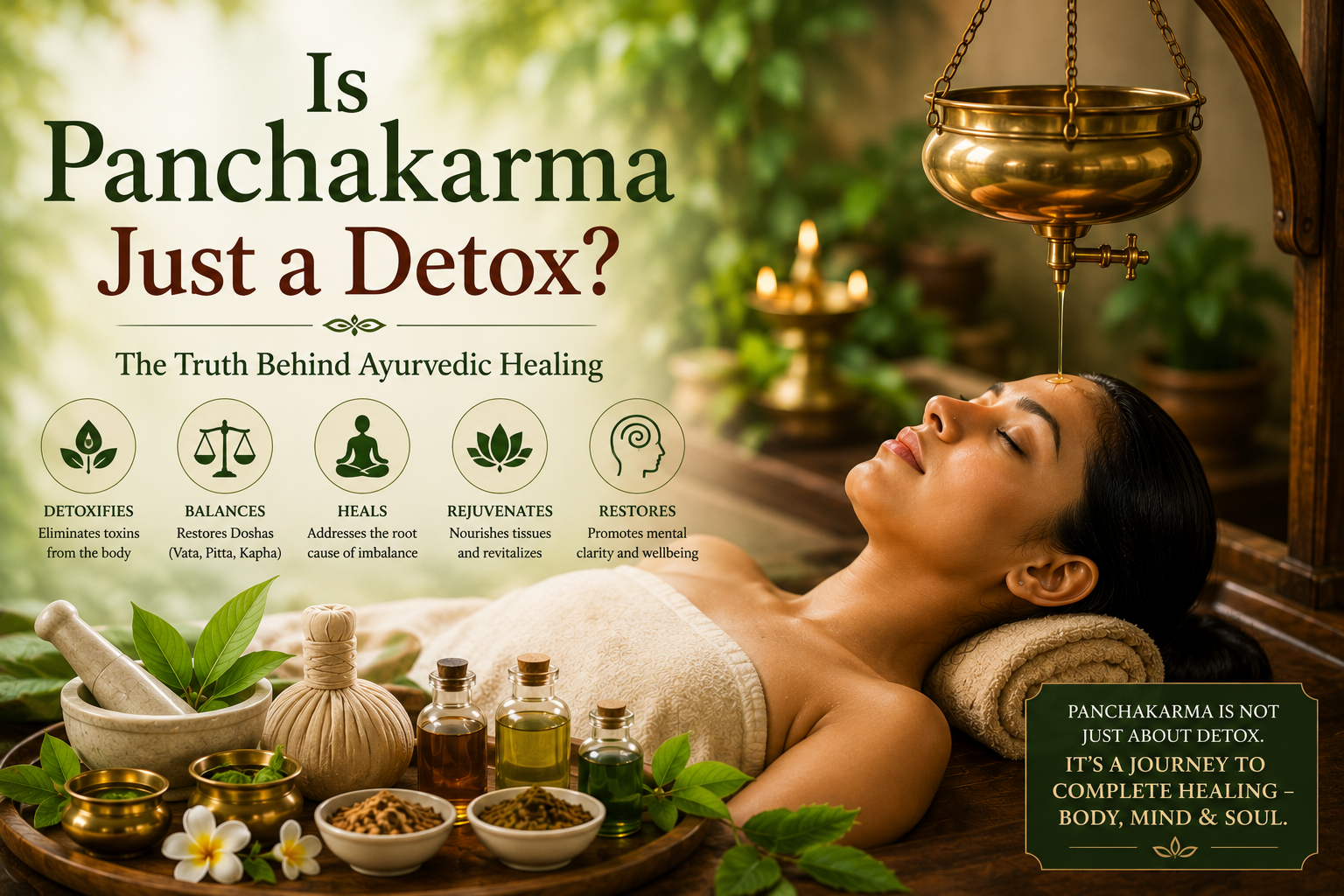
Understanding the Difference Between Authentic Panchakarma and Modern Detox Programs
One of the most common misconceptions about Panchakarma is that it is simply an Ayurvedic detox.
While this description is widely used, it only captures a small part of what Panchakarma actually represents according to the classical Ayurvedic texts.
Modern detox programmes often focus on short-term cleansing through juices, fasting, supplements, colon irrigation, or restrictive diets. Panchakarma, however, is a physician-guided medical system developed over thousands of years within Ayurveda. Its purpose extends far beyond cleansing. It seeks to restore the body’s natural state of physiological balance by addressing the underlying causes of disease according to Ayurvedic principles.
For this reason, authentic Panchakarma should never be viewed as simply another wellness trend. It is one of the most comprehensive therapeutic systems described in classical Ayurveda.
Why Is Panchakarma Often Called a Detox?
The word “detox” has become popular because it provides a simple English description for the Ayurvedic concept of Shodhana (Purification Therapy).
However, the two are not identical.
In modern healthcare, detoxification usually refers to the removal of harmful substances such as drugs, alcohol, or environmental toxins through the body’s natural organs, including the liver, kidneys, lungs, skin, and intestines.
In Ayurveda, Shodhana refers to the elimination of excessively aggravated Doshas (Vata, Pitta, and Kapha) after careful preparation. Although the English word “detox” is convenient, it does not fully express this broader therapeutic philosophy.
Rather than focusing on one organ, Panchakarma aims to restore harmony throughout the entire individual by improving digestion, metabolism, tissue function, circulation, elimination, and overall physiological balance.
Understanding the Ayurvedic Perspective
According to Ayurveda, health depends upon the harmonious functioning of several interconnected principles.
These include:
- Doshas (Functional Biological Regulators) that coordinate physiological processes.
- Agni (Digestive and Metabolic Capacity) responsible for digestion, transformation, and cellular metabolism.
- Srotas (Body Channels) through which nutrients, wastes, and biological substances circulate.
- Dhatus (Body Tissues) that provide structure and nourishment.
- Malas (Natural Waste Products) that must be eliminated efficiently.
When these systems remain in balance, health is maintained.
When they become disturbed, disease may gradually develop.
Panchakarma was designed to help restore this balance after appropriate clinical assessment.
What About Ama?
One of the most misunderstood concepts in Ayurveda is Ama.
Ama is often translated simply as “toxins.”
This translation is incomplete.
According to Ayurveda, Ama refers to incompletely digested or improperly processed substances resulting from impaired digestive and metabolic function. It is considered a Ayurveda concept rather than a direct equivalent of any single modern biochemical substance.
When digestive capacity (Agni) becomes impaired, Ama may accumulate and contribute to the aggravation of Doshas and obstruction of body channels (Srotas).
Many Panchakarma therapies begin by improving Agni and preparing the body before purification is attempted.
Classical Wisdom
Ayurveda emphasizes that purification should be performed only after appropriate preparation. Preparatory therapies help mobilize aggravated Doshas from peripheral tissues into the gastrointestinal tract, allowing them to be eliminated through the body’s nearest natural route.
This principle, explained by Acharya Chakrapani, forms the foundation of authentic Panchakarma.
Panchakarma Is a Process, Not a Procedure
One of the greatest differences between Panchakarma and commercial detox programmes is that Panchakarma follows a carefully structured sequence.
Every authentic Panchakarma programme consists of three distinct stages.
- Purva Karma (Preparatory Measures)
Preparation includes therapies such as:
- Deepana (Enhancing Digestive Capacity)
- Pachana (Digesting Ama)
- Snehana (Internal and External Oleation)
- Swedana (Therapeutic Sudation)
These therapies prepare the body for safe purification.
- Pradhana Karma (Main Purification Procedure)
Depending on the individual’s condition, one or more of the following may be prescribed:
- Vamana (Therapeutic Emesis)
- Virechana (Therapeutic Purgation)
- Basti (Medicated Enema Therapy)
- Nasya (Nasal Administration of Medicines)
Not every patient requires all five therapies.
Treatment is always individualized.
- Paschat Karma (Post-Therapy Care)
Recovery is an essential part of Panchakarma.
Following purification, patients undergo:
- Samsarjana Krama (Graduated Dietary Rehabilitation)
- Lifestyle guidance
- Gradual return to routine
- Herbal support where indicated
Without this recovery phase, Panchakarma is considered incomplete.
Panchakarma Is Not…
Authentic Panchakarma is not:
❌ A juice cleanse
❌ A fasting challenge
❌ A colon cleanse
❌ A massage package
❌ A luxury spa experience
❌ The same treatment for every patient
Panchakarma Is…
✔ Physician-guided
✔ Individually planned
✔ Based on classical Ayurvedic principles
✔ Performed after proper preparation
✔ Tailored to constitution and disease
✔ Followed by supervised recovery
Is There Scientific Evidence?
Modern scientific research is increasingly exploring Panchakarma and its effects on health.
Studies have investigated potential influences on:
- Quality of life
- Chronic pain
- Musculoskeletal disorders
- Stress and mental well-being
- Metabolic health
- Inflammatory markers
- Gut microbiota
While many findings are encouraging, Panchakarma should still be understood primarily within the framework of classical Ayurveda. Larger, high-quality clinical studies are needed to further clarify its mechanisms and long-term outcomes.
Balanced scientific communication is important because it reflects both the strengths of Ayurveda and the current state of evidence.
Physician’s Perspective
One of the first questions many international patients ask during consultation is:
“Will I be detoxed?”
My answer is usually:
“Panchakarma is not about making your body ‘cleaner’ overnight. It is about helping your body regain its natural capacity to regulate itself. Sometimes that involves purification, sometimes nourishment, and often both.”
For some patients, Panchakarma may involve only one purification procedure. Others may benefit more from digestive correction, supportive therapies, or rejuvenation. Authentic Ayurveda is not defined by how many treatments are performed, but by choosing the right treatment for the right person at the right time.
